toy1d — 1-D blurred-signal recovery
| At a glance | |
|---|---|
| Problem | A non-negative 1-D signal from its Gaussian-blurred, noisy observation — the tutorial and CI instance |
| Unknown | x(t) ≥ 0 on [0, 1] (softplus head), 128 samples |
| Physics | FFT Gaussian blur with σ = 0.02 in physical units, rebuilt at every curriculum resolution |
| Measurement | 128 blurred samples + 1 % noise, simulated on a 4× finer grid in float64 and area-averaged |
| Difficulty classes | bumps, spikes, mixed |
| Baselines | grid |
| Metrics | PSNR · MSE · relative error |
| Run | nefi run toy1d --smoke · nefi run configs/toy1d.yaml --plot |
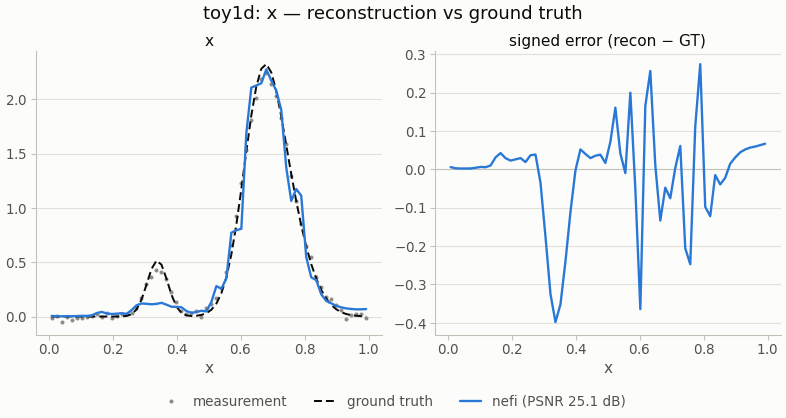
Gallery run (64 samples, 180 steps, 0.6 s on a CPU): PSNR 25.1 dB.
toy1d is the five-second instance: recover a non-negative 1-D signal x(t) on [0, 1] from its
Gaussian-blurred, noisy observation. It is small enough for continuous integration and the
tutorials, yet it exercises every core mechanism of nefi — a neural field with annealed Fourier
features, a softplus head, an FFT convolution rebuilt at every resolution, a two-stage multiscale
curriculum, TV / ℓ1 regularization and an inverse-crime-safe data generator.
bumps | spikes | mixed ─► Gaussian blur on a 4× finer grid (float64), area-averaged ─► y (128) + 1 % noise
coords ─► annealed Fourier PE ─► MLP ─► Softplus ─► x ─► FFTConvolution(σ = 0.02) ─► MSE + λ·TV (+ μ·ℓ1)
       ─► two-stage multiscale (64 → 128 samples) ─► PSNR / MSE / relative error
import nefi
from nefi.instances.toy1d import make_problem

problem, gt, meas = make_problem(n=128, seed=0)      # (InverseProblem, ground truth, Measurement)
result = nefi.invert(problem, device="cpu", seed=0)
print(nefi.metrics.psnr(result.fields["x"], gt["x"]))
CLI: nefi run toy1d [--scene spikes] [--plot], nefi bench toy1d --methods neural,grid --n 4
--seeds 0,1,2, nefi diagnose toy1d, nefi autotune toy1d --smoke. The full walk-through, with
the output of every command, is the quickstart tutorial.
Configuration (Toy1DConfig)
| field | default | meaning |
|---|---|---|
n |
128 | samples on [0, 1] |
sigma |
0.02 | Gaussian blur standard deviation, in physical units |
noise_std |
0.01 | noise relative to the clean signal's maximum |
scene |
bumps |
bumps (smooth), spikes (sparse), mixed |
supersample |
4 | the data generator's grid refinement (inverse-crime guard) |
hidden, depth, n_octaves |
64, 4, 6 | neural field width, depth and Fourier bands |
steps |
(300, 600) | steps of the coarse and the fine stage |
tv, l1 |
1e-4, 0 | regularization weights |
configs/toy1d.yaml spells the configuration out and configs/toy1d_smoke.yaml is the CI-sized
version used by --smoke and the gallery.
What it is used for
- Tutorials — quickstart, diagnostics and benchmarking all start here.
- Tests — the core solver, the CLI, batching, compilation and the auto-tuner are checked on it.
- Performance — the batched solver reaches 8.4× the per-problem throughput of sequential solving on a CPU at batch 64 (Performance).
- A cautionary benchmark — on this smooth, well-conditioned linear problem, at the gallery's short budget, the free grid beats the neural field (32.9 ± 4.2 dB against 22.0 ± 5.5 dB, Gallery · Performance); the representation prior pays off on harder operators (Limitations and caveats).