reaction_diffusion — Gray–Scott feed-rate inversion
| At a glance | |
|---|---|
| Problem | The spatially varying feed rate of a Gray–Scott system from a few snapshots of both species |
| Unknown | feed-rate field F(x) ∈ [Fmin, Fmax], 32² |
| Physics | Gray–Scott reaction–diffusion: conservative Laplacian, explicit Euler hitting the observation times exactly |
| Measurement | u and v at t = 25, 50, 75, 100 (8 × 32²) + noise; data with 4× smaller time steps in float64 |
| Difficulty classes | blobs, stripes |
| Baselines | grid |
| Metrics | PSNR · SSIM · relative error |
| Run | nefi run reaction_diffusion --smoke · full: nefi run configs/reaction_diffusion_full.yaml |
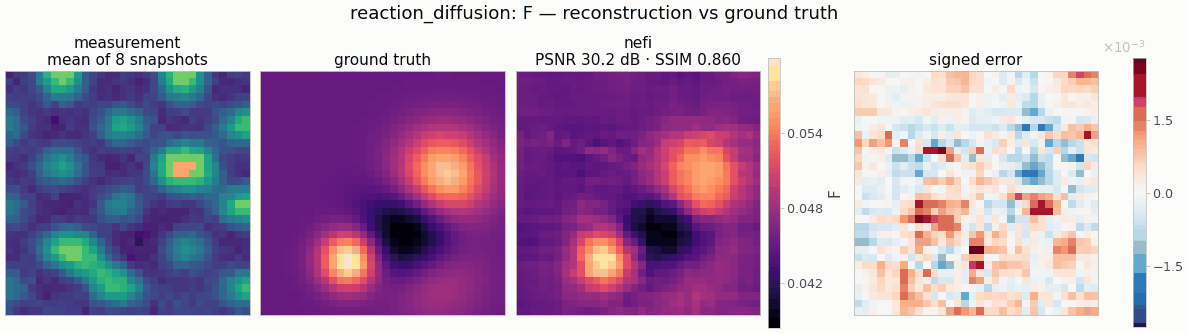
Gallery run (32², 250 steps, 4.3 s on a CPU): PSNR 30.2 dB.
Recover a spatially varying feed rate F(x) of the Gray–Scott system (Pearson 1993 units) from a
few snapshots of both species:
u_t = D_u Δu − u v² + F(x)(1 − u),     v_t = D_v Δv + u v² − (F(x) + k) v
data: (u, v)(t_i) for t_i ∈ obs_times  →  (n_times · 2, n, n) + noise
from nefi.instances.reaction_diffusion import ReactionDiffusion
inst = ReactionDiffusion(scene="stripes")
out = inst.run(seed=0)
out.metrics                                    # {"psnr", "ssim", "relative_error"}
nefi run reaction_diffusion --smoke, nefi run configs/reaction_diffusion_full.yaml.
Example: python examples/reaction_diffusion.py.
Physics and discretization
- Operator —
nefi.physics.reaction_diffusion.ReactionDiffusionOperator: conservative flux-form Laplacian with zero-flux (Neumann) boundaries, explicit Euler,dt_sim = dt/mwith the smallestmmeetingdt (D_max Σ4/h² + F_max + k + 1) ≤ 2(so snapshots att = 25, 50, 75, 100are hit exactly at every curriculum resolution). Known analytic initial condition (GrayScottIC:u0 = 1 − 0.5g,v0 = 0.25g,g ∈ [0.5, 1]a smooth cosine pattern) — it keeps the whole domain away from the trivial state(1, 0), whereF(1 − u) = 0andFwould be unobservable. Each pixel'sFinfluences a neighbourhood of radius ≈ √(2Dt) (≈ 3-6 cells over the observation window) — a nonlinear, diffusively coupled parameter-to-observable map. - Data generation (inverse-crime guard) — the same model with 4× smaller time steps in float64
(the O(dt) Euler error differs by ≈ 0.8 % of the data), optional 2× grid refinement
(
supersample), relative Gaussian noise. Tags: generatorgray-scott-substep4-float64, inversiongray-scott-euler. - Scenes (
ReactionDiffusionScenes):blobs(2-4 Gaussian perturbations of ±F_amplitude),stripes(smoothed square-wave stripes of random orientation and period 0.35-0.55 L).
Regime choice: with k = 0.06, regions with F ≲ 0.04 relax to the trivial state within ≈ 200
time units and later snapshots carry no information about them, while long windows become
chaotic; the window t ≤ 100 keeps the map smooth and informative for F ∈ [0.03, 0.06].
Prior, objective and curriculum
Neural field with a Bounded(F_min, F_max) head started at F_background; fit = relative MSE on
all snapshots, tv = isotropic TV on F; two-stage multiscale curriculum n/2 → n (coarse stages
simulate on the coarse grid and compare with area-averaged snapshots).
Configuration (ReactionDiffusionConfig, defaults = smoke preset)
| field | default | meaning |
|---|---|---|
n, extent |
32, 0.64 | grid, domain side (h = 0.02) |
scene, F_background, F_amplitude |
blobs, 0.045, 0.015 | phantom |
F_min, F_max |
0.02, 0.07 | head range (and stability bound) |
k, Du, Dv |
0.06, 2e-5, 1e-5 | known parameters |
dt, obs_times, observe |
1.0, (25, 50, 75, 100), (u, v) | time axis and observables |
boundary, ic_modes |
neumann, (2, 3) | boundary condition, initial pattern |
noise_std, gen_substeps, supersample |
0.01, 4, 1 | data generation |
grad_mode, checkpoint_every |
autograd, None | gradient memory |
hidden, depth, n_octaves |
64, 4, 6 | neural field |
tv, steps, lr, lr_decay, grid_lr_mult |
1e-4, (100, 150), 1e-2, 0.5, 10 | objective / optimization |
PRESETS["full"] / configs/reaction_diffusion_full.yaml: 128² over 2.56 (same h), six snapshots
up to t = 200, checkpointed gradients, 256 × 6 MLP, 1500 + 3500 steps.
Smoke results (CPU, seed 0)
| scene | uniform F_background |
grid | neural field |
|---|---|---|---|
| blobs (PSNR / rel. error) | 15.7 / 0.076 | 26.9 / 0.021 | 30.2 / 0.014 |
| stripes | 7.6 / 0.27 | 15.0 / 0.11 | 20.0 / 0.064 |
(≈ 4 s per neural-field run on a CPU.)
Baselines
grid (free-pixel F, same objective and curriculum, LR × grid_lr_mult).
Variants
ReactionDiffusionOperator(unknown="k") recovers the kill rate; unknown="Du" a spatially varying
diffusivity (conservative ∇·(D_u∇u) with harmonic-mean faces). observe=("u",) restricts the
data to one species (harder).