Edge refinement¶
A neural-field reconstruction of a piecewise-constant unknown finds the structures but draws
them with soft edges. refine_edges runs a short second stage that sharpens
the interfaces under the same operator and the same data, and accepts the result only if it
still explains the measurement. Every figure below shows the ground truth, the smooth result,
the continue control (the same extra budget without a sharpening prior) and each refinement
mode, with line profiles through the anomaly.
What the numbers say¶
Smoke presets at the gallery budget, seeds 0 / 1, CPU (python examples/refine_edges.py
--budget 0.1 --include-2d --seeds 0,1); full tables in Edge refinement § 6.
| instance | verdict of the default mode | what changed |
|---|---|---|
dot3d |
accepted | +3.2 / +2.8 dB, Edge-F1 0.42 / 0 → 1.0 at an unchanged data fit (χ 1.15 → 1.10); the control gains nothing |
photoacoustic3d |
accepted | +1.5 / +2.1 dB and +0.03 / +0.06 IoU over the control |
deconvolution3d |
accepted | +0.3 dB and +0.1–0.2 Edge-F1 over the control; the constant-phase variant is refused |
ct3d |
accepted | +3.7 / +3.9 dB, almost all of it from continuation (the control alone: +3.6 / +3.8 dB) |
deconvolution |
accepted | ties the control (+0.4 / −0.1 dB) |
eit |
refused | the level set would add +0.9 / +3.5 dB, but χ rises 1.01 → 1.24 / 1.06 → 1.33 — the default rule is conservative here |
thermal_tomography |
refused | the ground truth itself misfits the smoke data 14× / 5× worse than the smooth field: the data cannot certify a crisper answer |
Accepted is not the same as better, and refused is not the same as worse: the test certifies
consistency with the data, not accuracy. That is why every figure carries the continue
control, and why the refusals are shown. Limitations and caveats
discusses both cases.
Volumetric systems¶
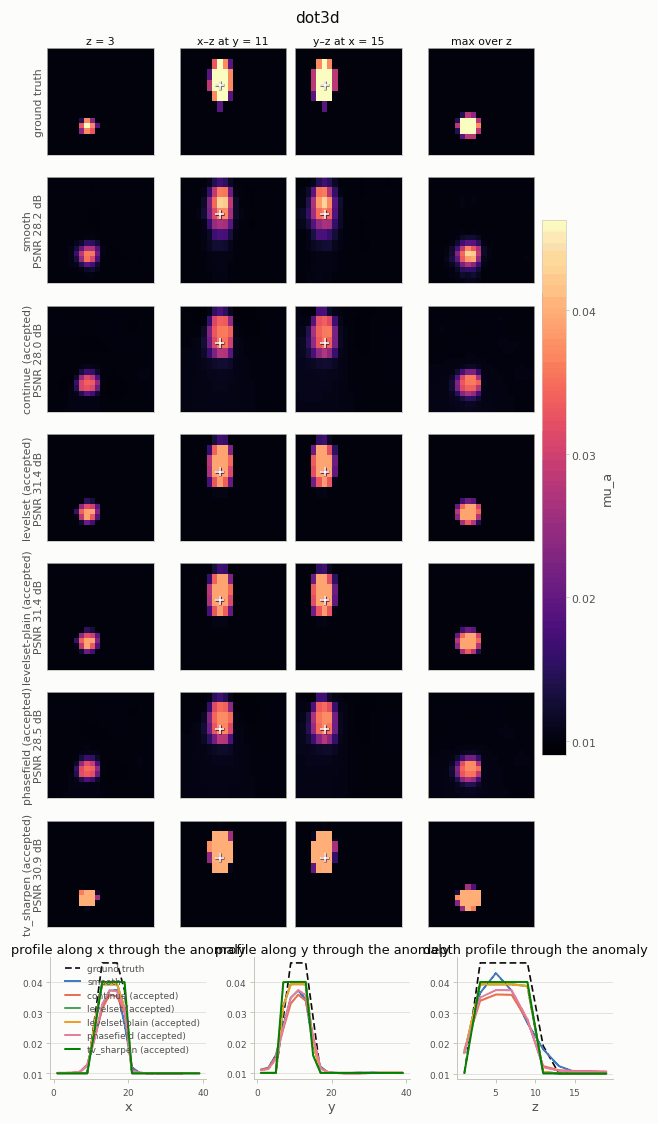
The textbook case: a homogeneous inclusion in a known background behind a strongly smoothing forward map. The level set recovers a crisp sphere at the same data fit.
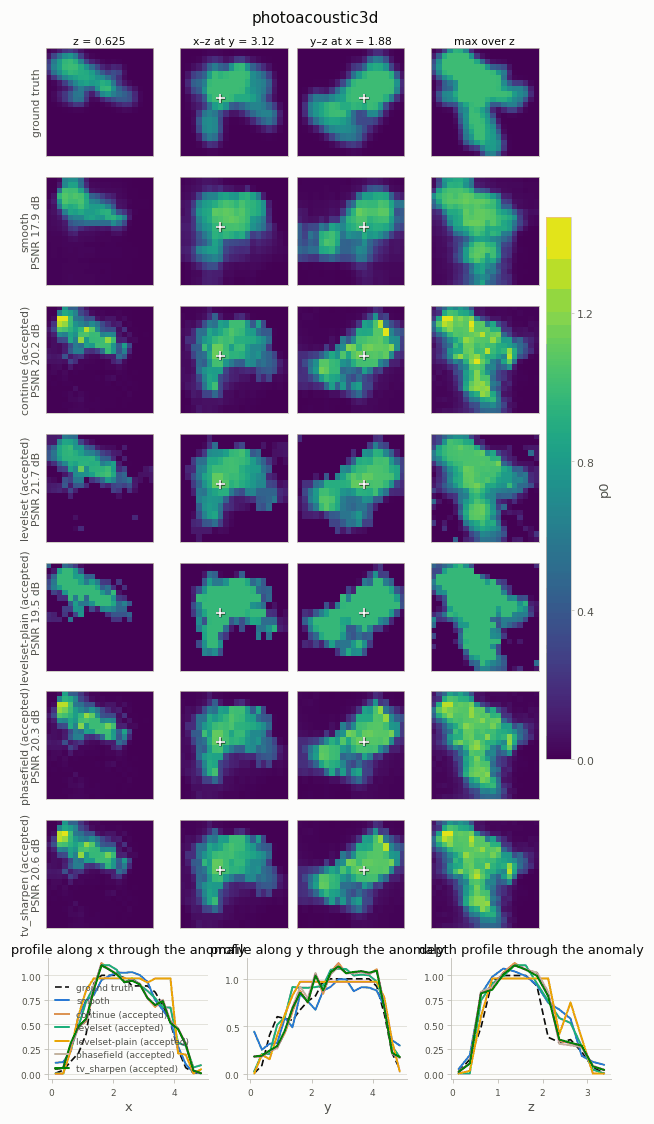
Absorbers of different amplitudes on a zero background: the default keeps phase 1 free, so each vessel keeps its own brightness inside a sharp outline.
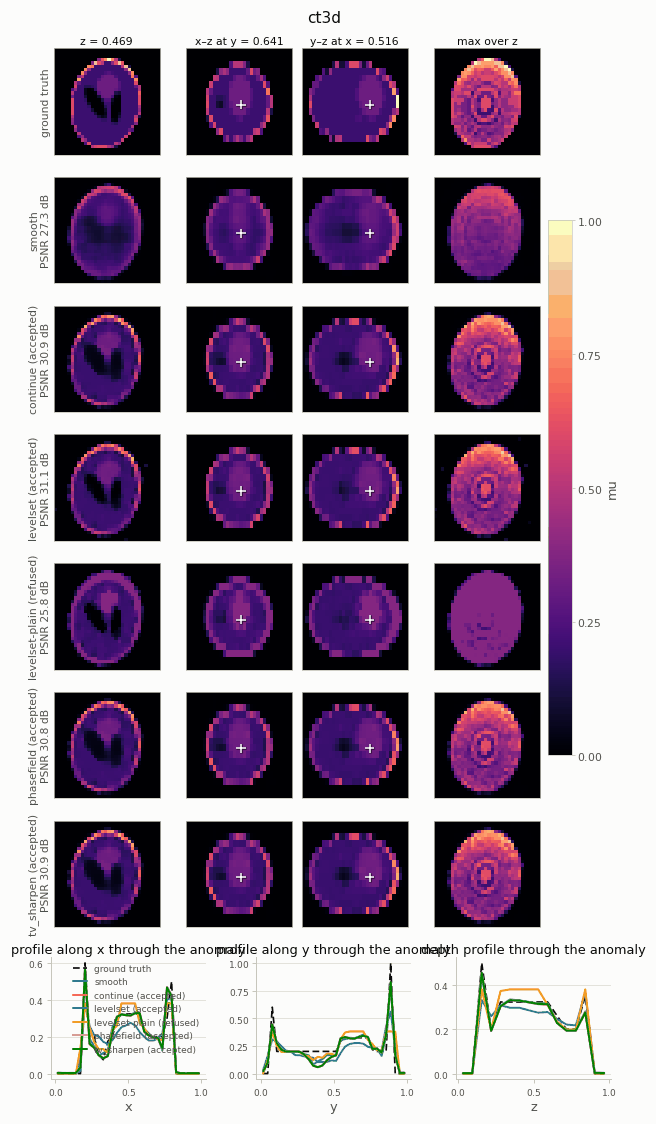
Most of the gain is continuation — compare the continue row. A two-phase level set cannot
hold the multi-tissue phantom and is refused.
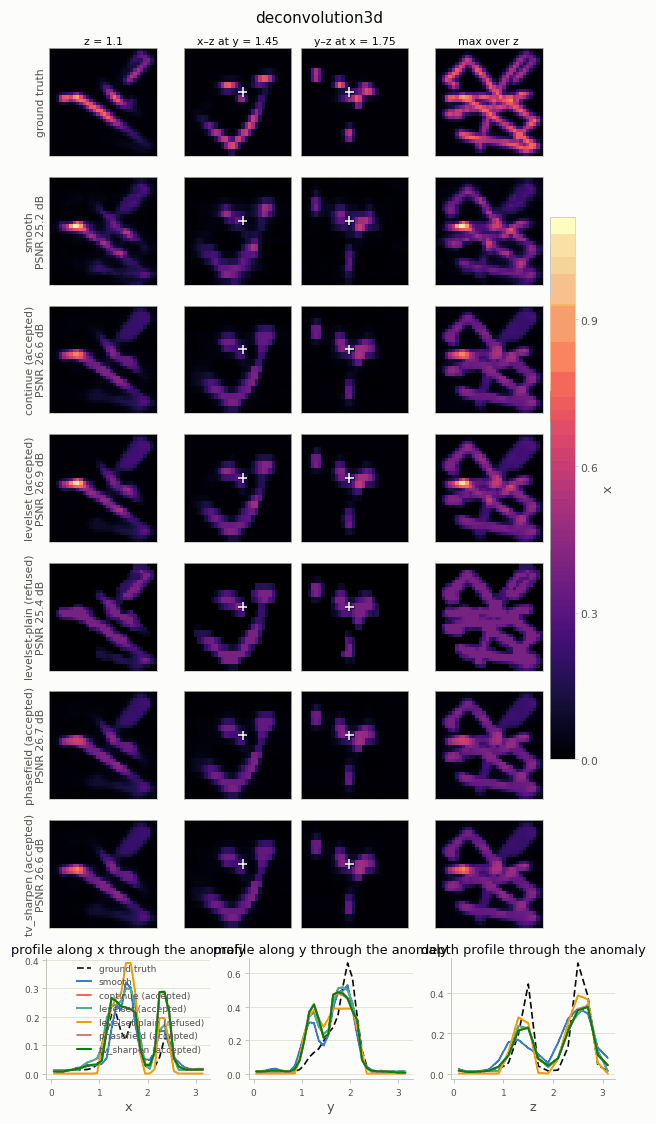
Filaments are not piecewise constant; with a free foreground the level set still sharpens them, while the constant-phase variant is refused.
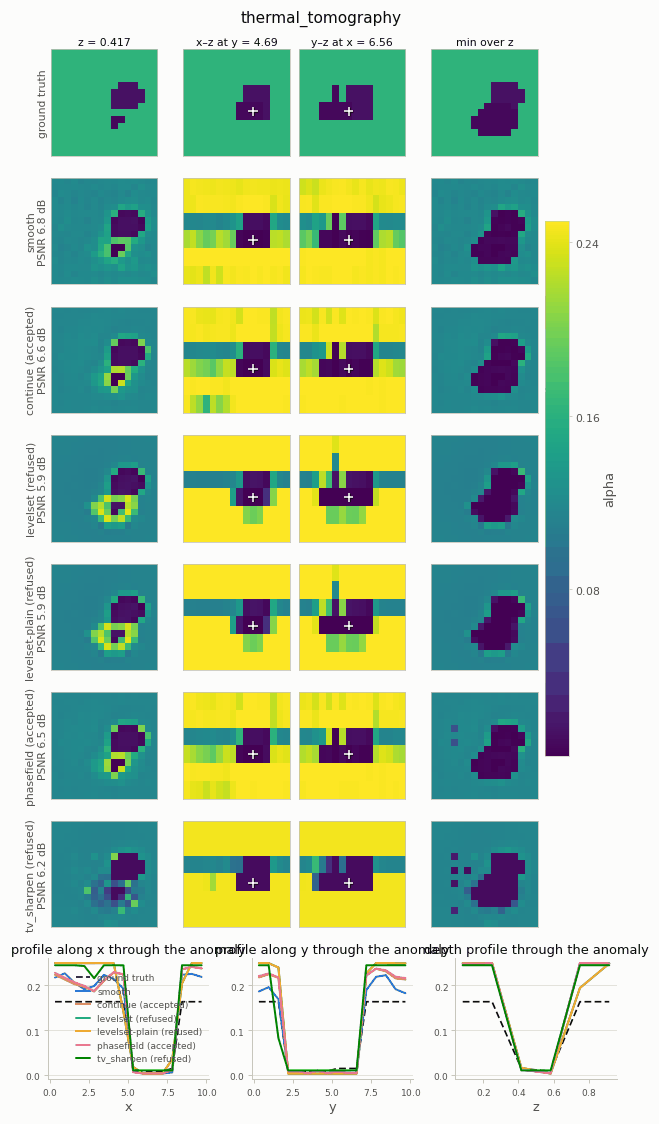
Refused on both scenes: the smooth field absorbs the model error of the coarse implicit time step, and any two-phase field fits the data 2–3× worse.
2-D systems¶


Try it¶
from nefi.solve.refine import refine_edges

result = nefi.invert(problem)                               # the smooth reconstruction
refined, report = refine_edges(problem, result, gt=gt)      # mode="levelset" by default
print(report.to_markdown())                                 # fit before → after, verdict, metrics

refined, report = inst.refine(result, measurement, gt=gt)   # instances pick the phase values